
How Oxidation-Reduction Potential (ORP) in Water Affects Absorption and Gut Health
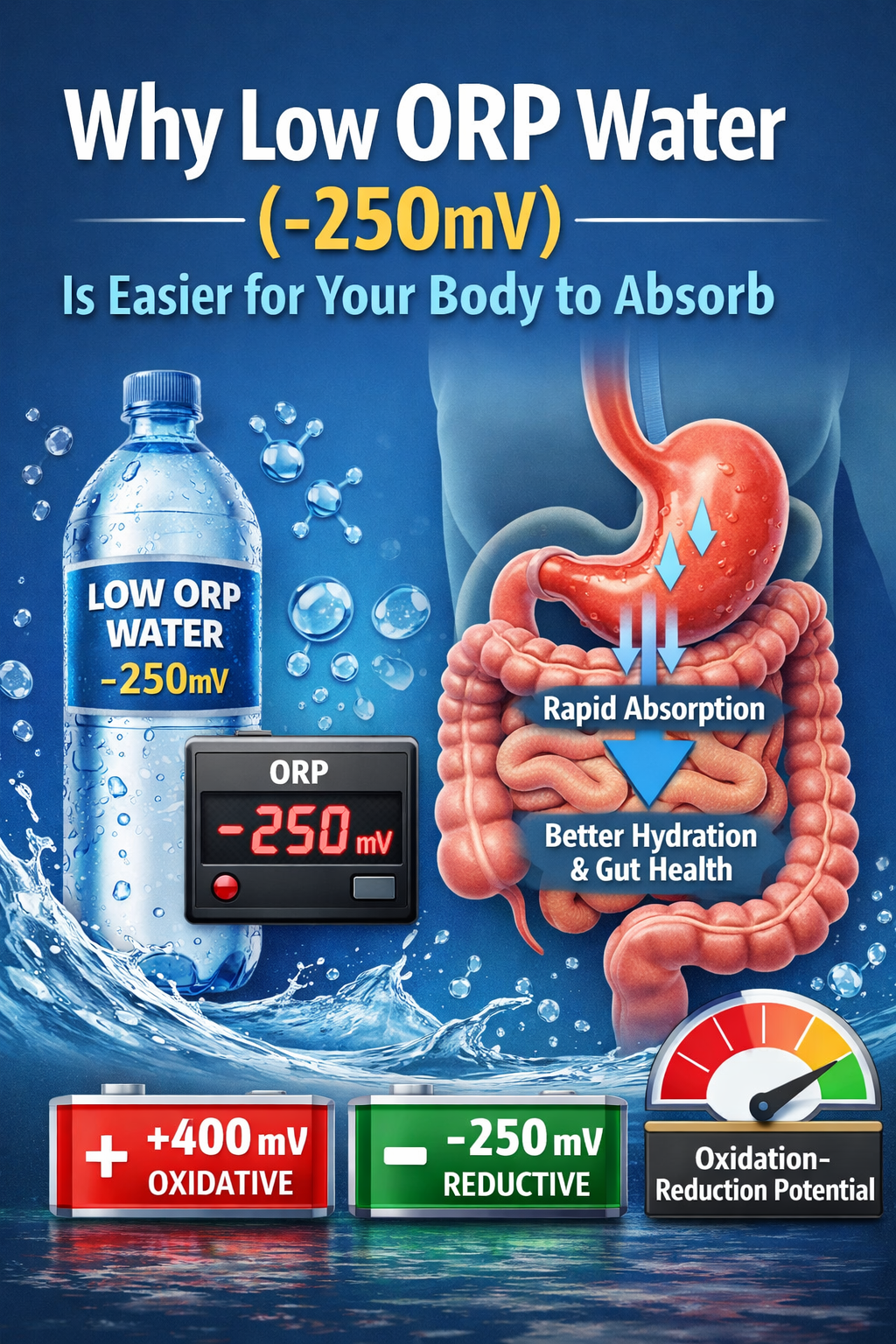
Understanding Water Absorption in the Human Digestive System
When we drink water, most absorption occurs in the small intestine, but the large intestine (cecum, colon, rectum) continues to absorb water from the remaining contents. Typically, the material entering the large intestine is more solid, indicating that most water has already been absorbed in the small intestine.
According to research cited in “Gut Microbes” by Professor Guanggang Hui from Japan, the redox potential (ORP) varies along the digestive tract:
| Digestive Section | ORP (mV) |
|---|---|
| Stomach | +150 |
| Duodenum & Jejunum | -50 |
| Ileum | -150 |
| Cecum | -200 |
| Rectum | -250 |
In contrast, ordinary tap water has a potential of +450 to +650 mV, while bottled or natural water is around +200 to +400 mV.
How ORP Affects Water Absorption
Water entering the stomach gradually undergoes redox changes as it passes through the digestive tract. The ORP slowly decreases, reaching about -250 mV in the rectum, where absorption is most effective.
This process, sometimes referred to as the “natural intake principle”, indicates that the oxidation-reduction potential of water is a key factor in how efficiently the body absorbs it.
- Drinking high ORP water requires the body’s gut microbiota and redox reactions to lower the potential before absorption.
- Low ORP water (around -250 mV) signals the digestive system that it is ready for absorption, allowing water to be taken up efficiently even in the upper digestive tract (mouth, esophagus, stomach).
Misconceptions About “Micro Water”
Some people believe that water molecules must be “small” to be absorbed quickly. However, the critical factor is not molecular size but redox potential.
- Water with a low ORP is more readily absorbed.
- The body recognizes this potential and triggers absorption pathways without waiting for microbiota to lower the ORP in the large intestine.
Practical Implications
- Choosing low ORP water can enhance hydration efficiency.
- It may reduce water retention in the stomach and improve fluid balance.
- Maintaining an appropriate ORP in drinking water aligns with the body’s natural absorption mechanisms.